


.svg)
.svg)
.svg)

Radial, Bias & Solid Tyres – Construction Explained
What is a Radial Tyre?
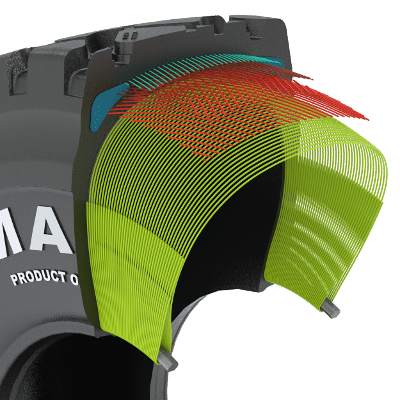
Steel radial tyres use steel cord plies running from bead to bead at a 90-degree angle to the direction of travel. Additional steel belts positioned beneath the tread provide structural stability and protect the contact area under load.
This construction separates sidewall flexibility from tread stiffness, allowing the tyre to maintain a wider footprint during operation. The larger contact area reduces rolling resistance, helping fleets improve fuel efficiency and lower operational costs. Reduced inter-ply friction also minimises heat build-up during continuous operations, supporting longer tyre life and more reliable performance in demanding duty cycles.
The steel belts beneath the tread improve puncture resistance, traction and stability, particularly in high-load and high-speed applications. As a result, radial tyre construction is widely used in mining haulage, port and terminal operations, quarrying and on-highway construction logistics where uptime, fuel efficiency and cost-per-hour directly impact productivity.
Operational Limitations: In harsh off-road or low-speed applications on uneven terrain, bias tyres may provide stronger sidewall resistance against impacts and surface damage. Radial tyres can also offer reduced self-cleaning performance in deep mud or aggressive terrain conditions. The correct tyre construction should therefore match the operating environment and application requirements.
What Is a Bias Tyre?
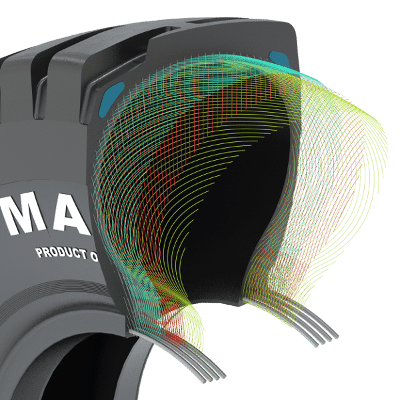
In a bias tyre, multiple plies of rubber-coated fabric cord, typically nylon, run diagonally across the carcass at angles of 30 to 40 degrees to the direction of travel. Successive plies are laid at opposing angles, forming a crisscross pattern that extends from bead to bead beneath the tread. This integrated ply structure means the sidewall and tread area form a single, unified construction.
That structural unity is what defines bias tyre behaviour in the field. The interlocked plies produce a robust, rigid sidewall with high resistance to impact and lateral stress. Under heavy point loads or repeated kerb strikes, bias construction absorbs and distributes force across the full carcass rather than concentrating it at a single point. This makes bias tyres well suited to low-speed, high-load applications where ground conditions are unpredictable and sidewall damage is a routine operational risk.
Bias tyres are a practical choice for port and terminal operations, heavy construction, and industrial material handling where equipment operates at low speeds over rough or uneven surfaces. The ride quality at low speeds is generally smoother than radial alternatives, which supports operator comfort during long shifts on uneven ground.
Operational limitations: The same carcass rigidity that provides impact resistance also generates more internal heat build-up at higher speeds, which accelerates tyre wear and increases the risk of heat-related failure. Fuel consumption is higher than with radial tyres due to greater rolling resistance. For mixed-duty or higher-speed applications, these factors affect tyre life and cost-per-hour and should be weighed carefully against the application requirements before specifying bias construction.
What Is a Solid Tyre?
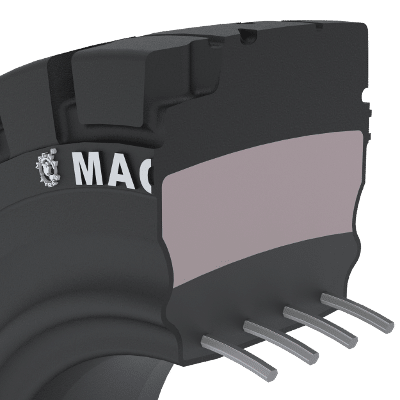
Solid tyres are engineered for industrial applications where puncture resistance, maximum durability and operational continuity are critical. Unlike pneumatic tyres, solid tyres are non-pneumatic and completely airless, eliminating the risk of flats and blowouts in demanding working environments.
Manufactured from high-strength rubber compounds, solid tyres are designed to withstand heavy loads, continuous pressure and exposure to sharp debris. Their rigid construction provides exceptional load stability and reliable performance in environments where downtime directly impacts productivity.
Solid tyres are commonly used in:
- Recycling and waste operations
- Glass and metal handling
- Forklift applications
- Industrial material handling
- Heavy-duty transport operations
Operational Benefits: Because solid tyres cannot puncture, they significantly reduce maintenance requirements and help maximise uptime in debris-heavy environments. Their robust construction also supports high load-carrying capacity and stable handling during intensive lifting and transport operations.
Choosing the Right Tyre Construction: A Practical Comparison
| Factor | Radial Tyres | Bias Tyres | Solid Tyres |
|---|---|---|---|
| Ride Comfort | High | Medium | Low |
| Heat Resistance | Excellent | Moderate | N/A |
| Puncture Resistance | Moderate | Moderate | Maximum |
| Fuel Efficiency | High | Lower | Low |
| Initial Investment | Higher | Lower | Medium |
| Downtime Risk | Medium | Medium | Minimal |
| Best Application | Long-duty cycles | Heavy-duty mixed terrain | Waste and recycling |
Download the Radial vs Bias Tyres White Paper
Compare the construction, performance and application differences between radial and bias tyres. Download the white paper for a practical overview that helps you select the right tyre construction for your operating conditions.