Industrial Solid Tires.
Solid tires keep industrial equipment moving where sharp debris, abrasive surfaces, and heavy loads are part of the daily workload. Because there is no air chamber, they eliminate pressure loss and the tire-related stops caused by punctures. This makes them a reliable choice for warehouses, manufacturing facilities, ports, scrap yards, recycling plants, and other demanding material-handling operations.
The right solid tire does more than resist punctures. It supports load stability, predictable maintenance, and a controlled cost per operating hour. Magna Tyres offers solid tire solutions for compact warehouse equipment and high-capacity industrial machines, with constructions, compounds, and tread patterns matched to different operating conditions.
Why Choose Solid Tires.
A flat tire can stop a machine at the most expensive point in a shift. The direct repair cost is only part of the impact. Downtime can interrupt material flow, delay loading, require an unplanned service call, and leave operators waiting. Solid tires remove air loss from this risk equation. Their rubber construction continues to support the machine when the tread encounters nails, glass, wire, metal fragments, or other sharp objects.
Solid construction also provides consistent load support. Performance does not depend on inflation pressure that can change because of leakage, temperature, or missed maintenance. Fleet managers can plan service around visible wear and recorded operating hours instead of reacting to unexpected pressure loss.
- No inflation-pressure checks or puncture repairs.
- Fewer unplanned stops on debris-covered or abrasive surfaces.
- Stable load support throughout the usable tread life.
- Gradual, visible wear that supports planned replacement.
- Limited sidewall deflection for controlled handling under load.
Solid tires are not the right answer for every job. Pneumatic tires can provide more cushioning and may deliver better ride comfort or flotation on rough, soft, or muddy ground. The correct choice depends on which risk matters most in your operation. Read our comparison of solid tires vs. pneumatic tires to assess puncture exposure, surface conditions, speed, traction, and operator comfort.
Construction Engineered for Industrial Work.
Solid tire performance depends on more than rubber volume. Compound formulation influences wear resistance, heat generation, vibration absorption, and resistance to cuts, oils, and chemicals. The construction must balance these properties with load capacity, operating speed, and tread design.
Softer compounds generally absorb more vibration and can improve operator comfort. Under high loads or continuous duty cycles, however, they may generate more heat and wear faster. Harder compounds can improve wear resistance and load support, but they may transfer more vibration to the machine and operator. Selecting the correct compound protects both service life and operating performance.
The tread pattern also has a direct operational role. A smooth profile reduces tread movement and rolling resistance on prepared floors. A traction pattern improves grip on outdoor surfaces, loose material, and contaminated work areas. Deeper tread provides a larger wear reserve, while open, self-cleaning designs help release material from the contact area. Cut-resistant designs are especially important where sharp waste or scrap can damage the tread surface.
Some applications require non-marking compounds. Food-processing facilities, pharmaceutical warehouses, electronics production, and other clean environments often need tires that do not leave visible black marks on the floor. Waste sites, scrap yards, and ports usually place greater emphasis on cut resistance, load capacity, stability, and heat control. Magna Tyres helps match these construction choices to the actual work cycle.
Types of Solid Tires.
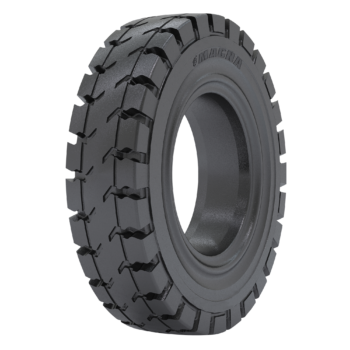
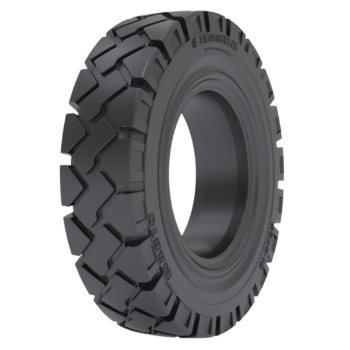
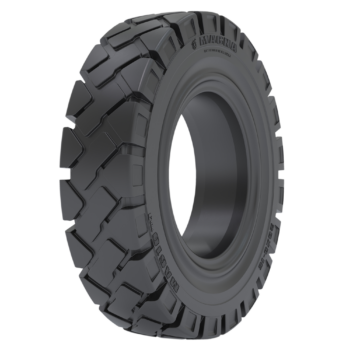
Press-on tires consist of a rubber tread bonded to a steel band and mounted on a matching cylindrical wheel. Their compact construction, low rolling resistance, and precise handling suit forklifts and other indoor equipment operating on smooth floors. They are often selected where maneuverability and predictable travel are more important than cushioning.
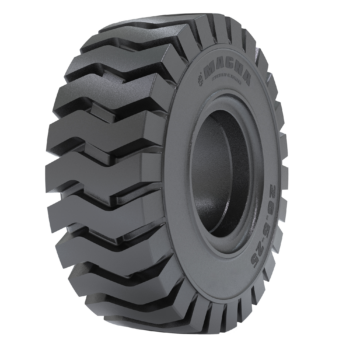
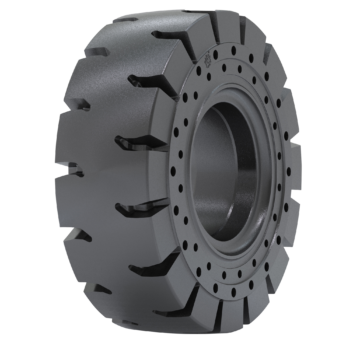
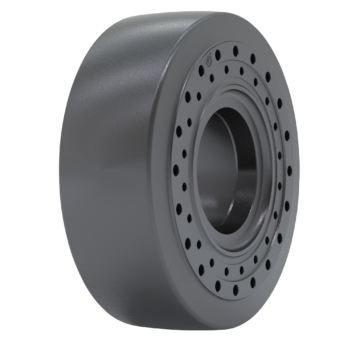
Solid resilient tires use a thicker rubber construction and fit compatible industrial rims. Depending on the design, multiple functional layers can combine a wear-resistant tread, a resilient center section, and a reinforced base. This construction provides more cushioning than a press-on tire while supporting heavier loads and demanding duty cycles. It is widely used for forklifts, loaders, telehandlers, material handlers, port equipment, and machines working in recycling or scrap operations.
Specialized options are available for high-load applications, twin-wheel arrangements, non-marking requirements, smooth-floor operation, and sites that need an aggressive traction pattern. Before choosing a size or construction, use our complete solid tire buyer’s guide to evaluate the load, speed, compound, surface, duty cycle, and total cost of ownership.
How to Select the Right Solid Tire.
Start with the machine manufacturer’s approved tire and rim specifications. Confirm the tire dimensions, rim profile, maximum wheel load, and permitted operating conditions. Machine weight alone is not enough. Lifting, braking, acceleration, cornering, attachments, and uneven load distribution can shift forces between axles and increase the load carried by individual tires.
Next, document the duty cycle. Record operating hours per shift, average travel distance, maximum speed, load frequency, idle periods, and the number of consecutive shifts. Long travel distances, sustained loads, and frequent direction changes increase internal temperature. Excessive heat can accelerate wear, weaken the compound, and reduce service life. A heat-managing construction helps maintain structural integrity during intensive work.
Assess every surface the machine crosses. Smooth concrete, rough asphalt, compacted gravel, steel plates, broken pavement, and floors covered with debris create different wear patterns. Include ramps, loading docks, indoor-to-outdoor transitions, moisture, oils, chemicals, and temperature changes in the assessment. The best tire is the one specified for the full route, not only the cleanest section of it.
Finally, review the operational priority. A warehouse may focus on rolling resistance, floor protection, and precise handling. A recycling plant may prioritize puncture elimination, cut resistance, and tread life. A heavy material handler may require maximum load stability and heat control. Bringing these factors together supports a safer, more predictable tire choice and reduces the risk of premature replacement.
Solid Tires for Industrial Machines.
Different machines place different forces on their tires. Magna Tyres supplies solid solutions for a broad range of industrial equipment, from compact warehouse vehicles to machines carrying heavy loads across abrasive outdoor sites.
- Solid forklift tires support stable lifting, consistent ride height, and accurate maneuvering in narrow aisles. Standard and non-marking options cover clean indoor floors, mixed indoor-outdoor routes, and intensive multi-shift operations.
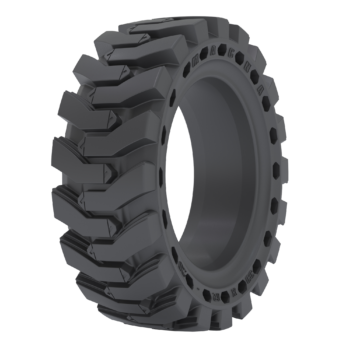
- Solid skid steer tires resist air loss during frequent counter-rotation and work around concrete, glass, metal, and demolition debris. Their stable footprint supports controlled handling under repeated lateral forces.
- Wheel loader tires must carry heavy material and withstand high forces during loading, braking, and turning. Solid constructions can improve damage resistance and service predictability in scrap, waste, and heavy industrial applications.
- Telehandler tires combine load support with traction and stability as the machine travels, lifts, and reaches. Solid options suit applications where sharp debris creates a high puncture risk, while site conditions determine the required tread pattern.
- Material handler tires support prolonged loads, frequent repositioning, and continuous work in ports, scrap yards, recycling facilities, and industrial plants. Construction and compound selection must control heat while resisting cuts and abrasion.
Performance in Waste and Recycling Operations.
Waste and recycling sites expose tires to glass, wire, nails, scrap metal, broken concrete, chemicals, and uneven compacted surfaces. In these conditions, pneumatic tire damage can stop the movement of material between sorting, processing, loading, and storage areas. The resulting delay affects more than one machine and can restrict the output of an entire line.
Solid tires eliminate air loss and allow equipment to continue working after ordinary tread penetration. Cut-resistant compounds and robust tread designs help protect the remaining rubber against chunking and accelerated wear. An appropriate tread pattern also maintains traction and releases debris from the contact area. Explore our waste and recycling tires for machines operating in these demanding environments.
The Magna MA801 and Magna MA802 are solid tire options developed for skid steers, telehandlers, and compact wheel loaders in demanding waste-handling conditions. The correct product depends on the machine configuration, required size, load, surface, and work cycle. For a deeper application review, see our guide to the best solid tires for waste management and recycling operations.
Puncture resistance does not remove the need for inspection. Operators should check for deep cuts, cracking, chunking, embedded material, uneven wear, and damage near the rim. Early detection can reveal overloading, excess heat, aggressive turning, alignment problems, or an unsuitable tread design before these factors reduce service life.
Reliable Tire Performance in Warehouses.
Warehouse equipment works in tight spaces where predictable handling and continuous availability are essential. Forklifts may travel thousands of short cycles, brake repeatedly, turn within narrow aisles, and carry loads close to their rated capacity. These movements create heat and concentrated wear even when the floor appears smooth.
The right warehouse tires combine load stability, low rolling resistance, and a compound suited to the operating hours. Smooth profiles support efficient travel on prepared floors. Treaded designs can provide extra grip where equipment crosses outdoor yards or wet loading areas. Non-marking options protect clean floors and sensitive products without giving up the structural support required for industrial work.
Service Life and Cost per Hour.
Purchase price alone does not show the value of an industrial tire. A more useful comparison includes acquisition, installation, service hours, planned replacement, unplanned downtime, and any effect on machine efficiency. A properly specified tire can justify a higher initial investment when it provides more productive hours and fewer service interruptions.
Start with a basic cost-per-hour calculation: add the purchase and installation costs, then divide the total by recorded service hours. For a fuller total cost of ownership calculation, include labor for tire changes and the estimated cost of tire-related downtime. Our analysis of solid tire lifespan and cost per hour explains which factors influence service life and how to compare alternatives using operating data.
Record the installation date, machine hours, application, axle position, and reason for removal. When a tire reaches its wear limit, compare actual performance with the original estimate. Over time, these records reveal whether shortened life is linked to the product specification, load, speed, surface, maintenance, or operator behavior. That evidence improves future purchasing decisions and gives fleet managers better control over TCO.
Maintenance for Predictable Results.
Solid tires require less routine attention than pneumatic tires, but they are not maintenance-free. Inspect tread depth, shoulder wear, cuts, chunking, and the bond between tire and wheel. Check that the tire remains secure on the rim and remove embedded debris when it can be done safely. Follow the tire and machine limits for load, speed, and wear.
Operating practices directly affect tire life. Hard acceleration, abrupt braking, high-speed cornering, and repeated stationary turning generate heat and scrub rubber from the tread. Keeping routes clear where possible, training operators, checking wheel alignment, and maintaining the machine reduce avoidable wear. Planned inspections also allow the team to schedule replacement before performance affects the operation.


.svg)
.svg)
.svg)