


.svg)
.svg)
.svg)

Complete Solid Tire Buyers Guide
What to assess before purchasing industrial solid tires.
Before specifying solid tires, document your equipment’s load capacity requirements, operational duty cycle, and floor surface conditions. If construction type is still an open question, comparing solid and pneumatic tires first clarifies which option actually fits your uptime and maintenance requirements before you get into load charts. Review the manufacturer’s load charts to determine maximum wheel loads during typical operations including lifting, tilting, and travelling with loads. Many forklift failures occur because operators select tires based solely on machine weight rather than dynamic loading conditions.
Measure your operating environment’s temperature range, floor type, and debris characteristics. Recycling facilities with metal fragments require different compound specifications than cold storage warehouses operating at -25°C. Document shift patterns and equipment utilisation rates, three-shift continuous operations demand higher-grade compounds than single-shift intermittent use.
- Equipment manufacturer specifications: wheel rim dimensions, bolt patterns, and maximum load ratings
- Daily operating hours and shift patterns affecting heat buildup
- Floor surface composition: concrete, asphalt, steel plates, or mixed surfaces
- Ambient and operational temperature ranges throughout the year
- Debris types: sharp metal, glass, wood splinters, or chemical exposure
How operating environment affects solid tire selection.
Operating temperature directly influences compound performance and service life. Standard rubber compounds perform optimally between -10°C and 40°C, but many industrial environments exceed these boundaries. Scrap yards where friction generates surface temperatures above 60°C require heat-resistant compounds that maintain structural integrity under thermal stress. Cold storage facilities below -20°C need compounds that resist hardening and maintain traction on frozen surfaces.
Floor contamination determines whether non-marking compounds are mandatory or optional. Food processing plants, pharmaceutical facilities, and clean manufacturing environments require non-marking tires that leave no visible residue. Port terminals and scrap handling operations prioritise durability over marking characteristics. Evaluate whether the minor durability trade-off of non-marking compounds justifies the cleanliness benefit in your specific application.
Terrain roughness affects tread pattern requirements. Smooth warehouse floors allow shallow tread depths that maximise compound volume and service life. Outdoor yards with uneven surfaces, gravel, or debris accumulation benefit from aggressive tread patterns that channel contaminants away from the contact patch and provide grip on loose materials.
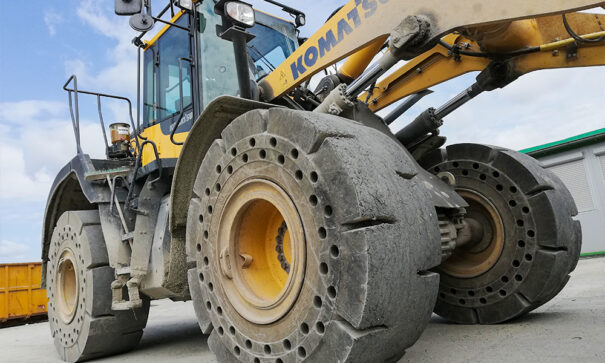
Load capacity, speed ratings and compound choices explained.
Load capacity ratings define the maximum static and dynamic loads a tire safely supports at specified speeds. Industrial solid tires typically operate between 0-25 km/h, but terminal tractors and reach stackers may exceed these speeds during transfer operations. Each 5 km/h increase above the base rating requires load capacity reduction according to manufacturer specifications, typically 5-10% per speed increment.
Compound hardness, measured in Shore A durometer, ranges from 65A for cushioned ride quality to 75A for maximum load capacity and wear resistance. Softer compounds (65-68A) absorb vibration and reduce operator fatigue but wear faster under heavy loads. Harder compounds (70-75A) extend service life in high-tonnage applications but transmit more shock to the machine and operator.
- Verify load ratings account for worst-case scenarios including maximum lift height with full load
- Calculate dynamic load factors: a forklift accelerating or braking multiplies static wheel loads by 1.3-1.5×
- Match compound hardness to duty cycle: intermittent use tolerates softer compounds, continuous operations require harder specifications
- Consider heat generation: higher speeds and loads increase internal temperatures requiring heat-resistant formulations
Comparing press-on, resilient and cushion solid tire types.
Press-on solid tires mount directly to a flat base wheel without a traditional rim, making them ideal for narrow aisle forklifts and indoor material handling equipment under 3 tonnes capacity. The simple mounting system reduces installation time but limits load capacity compared to other solid tire types. Press-on designs suit smooth floor applications where compact dimensions and manoeuvrability outweigh heavy-load requirements.
Resilient solid tires feature a rubber body bonded to a metal band that fits standard multi-piece rims. This construction supports loads up to 15 tonnes per wheel and accommodates the impact loads typical in port terminals, scrap yards, and heavy manufacturing. The thicker rubber section provides superior shock absorption and longer service life than press-on alternatives in demanding environments.
Cushion solid tires combine a solid rubber tread band with an aperture base that mounts to smooth-contour rims. The aperture design offers installation convenience similar to press-on tires whilst supporting higher loads. Cushion tires bridge the gap between press-on and resilient types, serving medium-duty applications including warehouse distribution and light manufacturing.
Total cost of ownership versus upfront tire pricing.
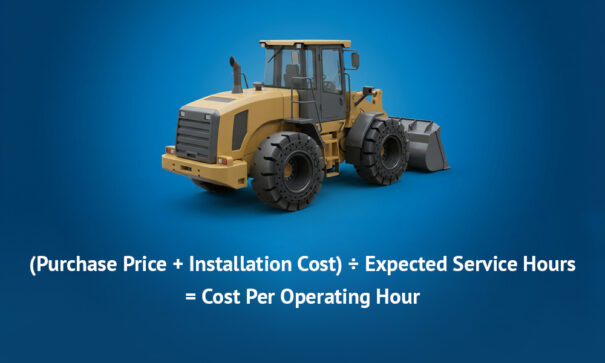
Initial purchase price represents 20-30% of solid tire total cost of ownership. The remaining costs accumulate through installation labour, machine downtime during tire changes, fuel consumption affected by rolling resistance, and disposal fees. A premium tire with 20% higher upfront cost but 40% longer service life reduces total cost per operating hour by 15-18%.
Calculate tire life based on compound volume and expected wear rate. A resilient solid tire with 50mm tread depth operating in moderate conditions typically delivers 4,000-6,000 hours before requiring replacement. Harsh environments with abrasive floors or sharp debris may reduce service life to 2,500-3,500 hours regardless of initial tread depth. For a detailed breakdown of how these hours translate into cost-per-hour, our lifespan and cost-per-hour analysis walks through the full calculation.
- Installation costs: press-on tires change in 15-20 minutes per wheel, resilient tires require 45-60 minutes and hydraulic presses
- Downtime costs: multiply hourly equipment operating costs by total installation time across all wheels
- Rolling resistance: harder compounds reduce fuel consumption by 3-7% compared to softer alternatives
- Disposal fees: larger resilient tires incur higher disposal costs that factor into lifecycle calculations
Which Magna solid tires suit material handling and port equipment.
Magna’s industrial solid tire range addresses applications from light warehouse forklifts to heavy-duty port handling equipment. The Magna MA608 Forklift provides heat-resistant compounds specifically developed for scrap handling and recycling environments where debris and friction generate extreme temperatures. For terminal tractors and reach stackers operating at higher speeds, the Magna MA600 range delivers enhanced stability and load capacity ratings suitable for container handling operations.
Stability and load capacity for RTG cranes, reach stackers and material handlers under sustained heavy loads.
- Non-marking compound options available across the range for clean floor environments without sacrificing core durability specifications
- Load capacity ratings from 2,000 kg to 18,000 kg per tire accommodate equipment from compact forklifts to heavy reach stackers
- Multiple tread patterns including smooth, traction, and self-cleaning designs optimised for specific floor conditions
-
Solid

MA608 FORKLIFT
- 15x4½-8
- 4.00-8
- 4.80-8
- 5.00-8
- 16x6-8
- 18x7-8
- 140/55-9
- 6.00-9
- 21x8-9
- 6.50-10
- 7.50-10
- 180/60-10
- 17¾x6½-10
- 200/50-10
- 23x9-10
- 7.00-12
- 24x7-12
- 23x10-12
- 27x10-12
- 5.50-15
- 6.00-15
- 7.00-15
- 7.50-15
- 8.25-15
- 28x9-15
- 250-15 (7.00)
- 250-15(7.50)
- 300-15
- 22¼x7½-15
- 28x12.5-15
- 32x12.1-15
- 400/60-15
- 7.50-16
- 8.25-20
- 9.00-20
-
Solid
MA600
- 16.00-25
- 18.00-25
- 20.5-25
- 23.5-25
- 26.5-25
-
Solid
MA610 PRO3
- 4.00-8
- 15x4½-8 (12.5/75-8)
- 16x6-8 (150/75-8)
- 18x7-8 (180/70-8)
- 5.00-8
- 15x5½-9 (140/55-9)
- 21x8-9 (200/75-9)
- 6.00-9
- 200/50-10
- 6.50-10
- 23x9-10 (225/75-10)
- 7.00-12
- 23x10-12 (250/60-12)
- 27x10-12 (250/75-12)
- 7.00-15
- 7.50-15
- 28x9-15 (225/75-15)
- 8.25-15
- 2.50-15 (250/70-15)
- 300-15 (315/70-15)
- 28x12½-15 (355/45-15)
- 355/65-15
- 9.00-20
- 10.00-20
- 12.00-20
- 355/50-20
- 465/55-20
- 12.00-24
- 14.00-24


Key considerations for long-term solid tire performance.
Monitor tire wear patterns to identify operational issues before catastrophic failures occur. Uneven wear across the tread width indicates alignment problems, overloading, or incorrect tire pressure on hybrid solid-pneumatic designs. Centre wear suggests chronic overloading or excessive speed, whilst shoulder wear points to aggressive cornering or misalignment.
Inspect for compound chunking, cracking, or delamination during routine maintenance intervals. Chunking occurs when debris impacts exceed the compound’s tear resistance, typically in recycling and scrap environments. Cracking develops from ozone exposure, temperature cycling, or compound aging, particularly in tires stored outdoors before installation. Delamination between rubber layers signals manufacturing defects or thermal damage from sustained overloading.
Establish replacement thresholds based on remaining tread depth and compound condition rather than arbitrary time intervals. Most resilient solid tires remain serviceable until tread depth reaches 15-20mm, at which point heat dissipation decreases and failure risk increases. Early replacement before reaching minimum tread depth wastes compound life, whilst operation beyond safe limits risks sudden failures and equipment damage.
Summary: solid tire purchasing priorities for industrial operations.
- Document equipment specifications, load requirements, and operating environment conditions before requesting quotations to ensure accurate tire selection
- Match compound hardness and construction type to your duty cycle, continuous operations require premium specifications that justify higher initial investment
- Calculate total cost of ownership including installation, downtime, and service life rather than focusing solely on purchase price
- Select tread patterns and compound features (heat resistance, non-marking) based on specific floor conditions and contamination types in your facility
- Implement regular inspection protocols to identify wear patterns and address operational issues before tire failures cause extended downtime