


.svg)
.svg)
.svg)

Best Solid Tires for Waste Management & Recycling Operations
How solid tires perform in waste management environments
Waste and recycling facilities generate extreme tire stress. Glass shards, metal scraps, chemical residues and uneven compacted surfaces create puncture hazards and accelerated wear patterns. Solid tires eliminate air-filled chambers, removing the primary failure mode in these conditions. Forklifts handling baled recyclables, compactors crushing municipal waste and wheel loaders shifting sorted materials all operate continuously across debris fields where pneumatic tyres would suffer repeated punctures. For a broader view of the selection criteria behind this shift, our complete solid tire buyer’s guide covers the fundamentals before you specify equipment-specific compounds.
Operational continuity drives solid tire adoption in waste management. A single pneumatic puncture halts material flow, delays truck loading schedules and requires immediate maintenance intervention. Solid tires maintain structural integrity when penetrated by sharp objects, allowing operators to complete shifts without interruption. This translates to measurable productivity gains in facilities processing 200-500 tonnes of material daily.
Why puncture resistance matters for compactor and forklift operations
Puncture-proof construction delivers quantifiable benefits in waste handling. Compactors traversing landfill surfaces encounter nails, rebar fragments and broken glass hourly. Forklift operators manoeuvring between sorting lines face similar hazards from metal banding, broken pallets and industrial packaging waste.
- Zero downtime from punctures, solid rubber construction eliminates air loss and maintains load capacity regardless of penetration depth
- Predictable maintenance scheduling, wear becomes the only replacement trigger, enabling planned downtime rather than emergency repairs
- Consistent handling characteristics, solid tires maintain identical performance from installation through end-of-life, unlike pneumatics that change behaviour as pressure fluctuates
- Reduced operator risk, eliminating catastrophic tire failures removes sudden handling changes that cause accidents in high-traffic facilitie
Material composition and durability in harsh waste handling conditions
Solid tire compounds balance cut resistance, load capacity and heat dissipation. Natural rubber blends provide flexibility for shock absorption across uneven compacted surfaces, whilst synthetic compounds deliver superior resistance to oils, solvents and chemical exposure common in recycling streams. Advanced solid tire formulations incorporate carbon black reinforcement and proprietary hardening agents that extend service life beyond 8,000 operating hours in severe-duty applications.
Heat generation limits solid tire performance in continuous-use scenarios. Unlike pneumatic tires that dissipate heat through air circulation, solid constructions rely entirely on compound thermal properties and operational speed management. Facilities running three-shift operations must specify solid tires engineered for sustained heat cycles. Tread depths of 25-35mm provide wear reserves that maintain traction and puncture protection throughout the tire’s economic life.
Comparing solid rubber tires to pneumatic options for recycling facilities
Magna’s solid tire range addresses specific waste management applications through targeted compound engineering and tread design. For a full breakdown of where each construction performs best, see our comparison of solid tyres vs pneumatic tyres. Whilst detailed product specifications require direct consultation, Magna’s industrial solid range includes models optimised for forklift stability, compactor traction and loader durability in recycling operations.
- Press-on band solid tires for electric and LPG forklifts, designed for smooth warehouse floors and outdoor debris zones with seamless transitions
- Resilient solid tires for heavy-duty material handlers, engineered for shock absorption in loading applications whilst maintaining puncture immunity
- High-load solid tires for waste compactors, formulated to withstand continuous compression cycles and aggressive surface contact without chunking or tearing
Proper fitment requires tire press equipment for press-on installations. Magna’s technical team specifies compound hardness, tread pattern and load ratings based on equipment type, daily tonnage processed and surface conditions. Facilities handling corrosive waste streams benefit from chemical-resistant compounds, whilst operations prioritising maximum service life select harder formulations accepting slightly reduced ride comfort.
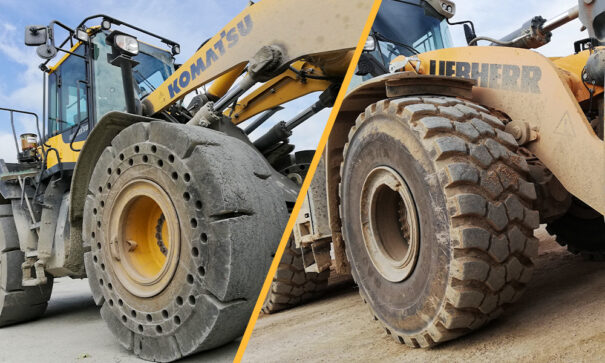
Performance outcomes: uptime, TCO and operational efficiency
Waste facilities switching to solid tires report uptime improvements of 15-25% through puncture elimination alone. A 30-tonne forklift fleet operating 16 hours daily previously experiencing 2-3 pneumatic failures weekly eliminates those interruptions entirely. Material throughput increases proportionally as equipment remains continuously available for loading, sorting and transfer operations.
TCO analysis over 36-month periods demonstrates solid tire value. Initial costs run 40-60% higher than pneumatic equivalents, but elimination of mid-life replacements, emergency call-outs and lost productivity generates net savings of 25-35%. For the full hour-by-hour cost model behind these figures, see our lifespan and cost-per-hour analysis. Predictable wear patterns enable scheduled replacements during planned maintenance windows rather than reactive repairs during peak operational periods. Facilities achieve further savings through reduced spare tire inventory, fewer tire types and longer service intervals require less warehoused stock.
Top-rated solid tires for waste management trucks and machinery
Selecting the right tire depends on the machine, not just the environment. The three models below cover the most common waste and recycling applications: forklifts, material handlers and heavy scrap/waste-site duty.

MA608 FORKLIFT

MA608 TWIN WHEEL

MA601
Summary: solid tire selection for waste operations
- Solid tires eliminate puncture downtime in debris-heavy waste and recycling environments where sharp objects constantly threaten pneumatic constructions
- Material composition balances cut resistance, load capacity and heat dissipation for continuous-use forklift, compactor and loader applications
- TCO calculations favour solid tires despite higher purchase costs through extended service life, zero puncture repairs and predictable replacement scheduling
- Proper specification requires matching compound hardness, tread design and load ratings to specific equipment types and waste stream characteristics
- Uptime gains of 15-25% translate directly to increased material throughput and reduced operational disruption in high-volume facilities