


.svg)
.svg)
.svg)

How Long Do Solid Tires Last? Lifespan Analysis & Cost Per Hour
What determines the lifespan of solid tires?
The lifespan of solid tires depends on several measurable factors. Load utilisation is one of the most important. Operating a forklift at around 80% of its rated capacity can extend tire life compared with continuous operation at or above the maximum load. Before selecting a construction, compound or load rating, consult our complete solid tire buyer’s guide.
Surface conditions also have a significant effect. Smooth concrete warehouse floors cause limited wear, while rough asphalt, gravel yards and surfaces containing metal debris accelerate tread degradation. A forklift operating indoors typically reaches 3,000 to 5,000 service hours before its tires require replacement. Outdoor machines working on aggressive surfaces may require new tires after approximately 2,000 hours.
Operating speed and duty-cycle intensity also influence tire life. Continuous operation generates heat within the tire compound, accelerating chemical degradation. Shorter operating periods with sufficient cooling time between shifts can extend service life. Equipment working three shifts per day generally experiences faster wear than equipment used for a single shift, even under similar surface conditions.
Compound hardness creates an operational trade-off. Harder compounds resist wear for longer but transmit more vibration to the machine and operator. Softer compounds improve ride comfort and shock absorption but wear faster under heavy loads.
Typical lifespan of solid tires in different applications.
Warehouse forklifts operating on smooth surfaces typically achieve 4,000 to 6,000 service hours. These applications provide controlled conditions, predictable loads and limited surface abrasion. Some operations exceed 7,000 hours through correct tire selection, load management and operator behaviour.
Port and terminal equipment faces more demanding conditions. Reach stackers and terminal tractors operating on rough asphalt typically achieve 2,500 to 4,000 hours. Heavy loads, sharp turns and abrasive surfaces reduce tire life compared with warehouse applications. Container handlers that regularly operate at maximum load tend to reach the lower end of this range.
Mining, construction and waste-handling environments create the most aggressive operating conditions. Solid tires fitted to telehandlers or compact loaders in these applications typically last between 1,500 and 3,000 hours. Sharp rock, metal debris and uneven ground accelerate wear. Solid tires can still provide an operational advantage because they eliminate puncture-related downtime. For applications involving scrap, glass and industrial waste, see our guide to the best solid tires for waste management and recycling operations.
Agricultural material-handling equipment sits between controlled warehouse applications and demanding outdoor operations. Solid tires fitted to agricultural forklifts typically achieve 3,000 to 4,500 hours, depending on surface quality, load intensity and seasonal usage patterns.
Wear patterns: how to recognise when solid tires need replacement.
Centre wear often indicates overloading or excessive speed. The tread wears faster in the middle than at the edges, creating a rounded profile. This pattern suggests that the tire is operating beyond its intended parameters and may require premature replacement.
Shoulder wear appears as excessive degradation along the edges of the tire. It usually indicates aggressive cornering, misalignment or unsuitable operating conditions. Operators who take tight corners at excessive speed can significantly accelerate shoulder wear.
Chunking is one of the most serious wear patterns. Pieces of rubber compound break away and leave irregular cavities in the tread. This can happen when the tire repeatedly travels over sharp objects or when the compound has degraded through heat or chemical exposure. Once chunking becomes significant, replacement is necessary to protect the machine and maintain safe operation.
Manufacturers generally define replacement limits according to remaining tread depth, tire condition and application. As the tread approaches its minimum safe depth, traction decreases, heat dissipation changes and the risk of accelerated wear increases.
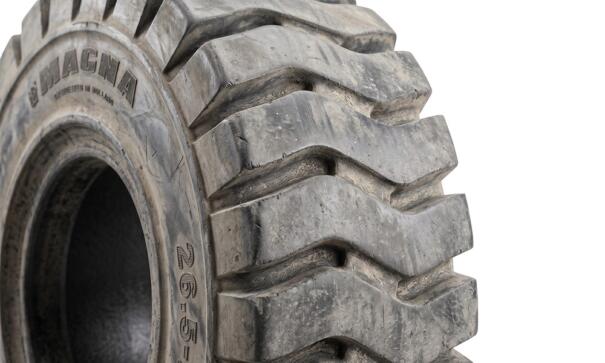
Cost per hour: the real cost of solid tires.
The initial purchase price tells only part of the story. A solid tire costing $800 and delivering 4,000 operating hours costs $0.20 per hour. A lower-priced tire costing $600 but lasting only 2,500 hours costs $0.24 per hour. Despite the lower initial investment, its hourly cost is 20% higher.
| Tire price | Service life (operating hours) | Cost per operating hour |
|---|---|---|
| $1,024 | 4,000 hours | $0.26 |
| $768 | 2,500 hours | $0.31 |
In many operations, the cost of downtime is considerably higher than the cost of the tires themselves. Pneumatic tires require regular pressure checks and puncture repairs. Solid tires eliminate these requirements. A warehouse losing $150 for every hour that a forklift remains out of service can save thousands each year by preventing puncture-related interruptions.
Labour costs also affect total cost of ownership. Mounting solid tires requires specialist equipment and trained technicians, which can increase installation costs. However, solid tires are normally fitted once per lifecycle instead of being removed repeatedly for puncture repairs. In high-utilisation environments, this generally reduces labour costs per operating hour.
Vibration can create additional equipment costs. Solid tires transmit more shock to the machine than pneumatic alternatives. This may accelerate wear on suspension components, masts and hydraulic systems. Operators should balance tire longevity and puncture resistance against the maintenance requirements of the complete machine.
How to calculate the cost per hour of solid tires.
The basic formula divides the total tire investment by the expected service life:
(Purchase price + installation cost) ÷ expected service hours = cost per operating hour
Example calculation.
A tire with a purchase price of $960 and an installation cost of $190 represents a total investment of $1,150. If the tire delivers 3,500 operating hours, the hourly cost is: $1,150 ÷ 3,500 = $0.33 per operating hour.
This calculation allows direct comparison between tire options with different purchase prices and expected service lives.
Including downtime costs.
Downtime can significantly influence the actual operating cost of a tire.
For example:
- Equipment downtime cost: $260 per hour
- Annual tire-related downtime: 2 hours
Total annual downtime cost: 2 × $260 = $520
Spread across a 3,500-hour tire lifecycle, this adds: $520 ÷ 3,500 = $0.15 per operating hour.
Even short interruptions can therefore increase the actual operating cost of a tire.
Track real performance using the equipment hour meter. Record the installation date and operating hours, then measure them again when the tire is replaced. This data shows whether the original calculations were accurate or need adjustment for future purchasing decisions. Actual service hours often differ from manufacturer estimates because every operation has its own loads, surfaces, speeds and duty cycles.
Fleet-monitoring systems such as Magna TPMS enable accurate lifecycle tracking across multiple machines. This data-driven approach supports replacement planning based on actual wear patterns rather than estimated schedules.
Choosing the right solid tire for maximum service life.
Match the tire compound to the application. Standard compounds suit general warehouse operations. Harder compounds extend service life in highly abrasive environments but increase vibration. Applications involving extreme loads, high temperatures or specific surface types may require specialised formulations.
Load-rating selection has a direct impact on longevity. Consistent operation at 70% to 80% of rated capacity supports longer tire life. Selecting a tire with an insufficient load rating can cause premature failure, regardless of compound quality.
Tread depth also affects service hours. Deeper tread patterns generally provide a larger wear reserve but cost more initially. Calculate whether the additional operating hours justify the higher purchase price. In many high-utilisation applications, deeper tread delivers a lower cost per hour.
Consider the complete operational context. Comparisons between solid tires and pneumatic tires show that solid tires provide longer and more predictable service in applications with a high risk of punctures, even when pneumatic alternatives may offer more operating hours in controlled conditions.
The Magna M600demonstrates an application-specific design for port and material-handling equipment. Its compound formulation balances wear resistance and load capacity for reach stackers and container handlers operating in demanding environments.
-
Solid

MA600
- 16.00-25
- 18.00-25
- 20.5-25
- 23.5-25
- 26.5-25
-
Solid
MA801 TR
- 13.00-24
- 14.00-24
-
Solid
MA610 PRO3
- 4.00-8
- 15x4½-8 (12.5/75-8)
- 16x6-8 (150/75-8)
- 18x7-8 (180/70-8)
- 5.00-8
- 15x5½-9 (140/55-9)
- 21x8-9 (200/75-9)
- 6.00-9
- 200/50-10
- 6.50-10
- 23x9-10 (225/75-10)
- 7.00-12
- 23x10-12 (250/60-12)
- 27x10-12 (250/75-12)
- 7.00-15
- 7.50-15
- 28x9-15 (225/75-15)
- 8.25-15
- 2.50-15 (250/70-15)
- 300-15 (315/70-15)
- 28x12½-15 (355/45-15)
- 355/65-15
- 9.00-20
- 10.00-20
- 12.00-20
- 355/50-20
- 465/55-20
- 12.00-24
- 14.00-24


Conclusion: why service life and cost per hour matter.
- Service hours vary by application: approximately 4,000 to 6,000 hours in warehouses, 2,500 to 4,000 hours in ports and 1,500 to 3,000 hours in construction and mining environments.
- Cost-per-hour calculations show the actual value of a tire. Divide the total investment by the achieved service hours and include downtime costs for a complete analysis.
- Wear patterns can reveal operational problems. Centre wear may indicate overloading, shoulder wear can signal aggressive cornering or misalignment, and significant chunking requires replacement.
- Correct tire selection supports return on investment. Match compound hardness, tread design and load rating to the application and operating conditions.
- Total cost of ownership extends beyond the purchase price. Include installation, downtime, maintenance and equipment wear when comparing solid tire options.