


.svg)
.svg)
.svg)

How to Calculate the Cost per Hour of Mining and Earthmoving Tires
The purchase price of a tire is easy to compare. Its true operating cost is more difficult to see. A lower-priced tire may require earlier replacement, suffer more damage or cause additional downtime. A tire with a higher initial price can deliver a lower cost per hour when it remains productive for longer. Cost per hour gives fleet managers and procurement teams a more reliable way to evaluate tire performance. It connects tire expenditure to the operating hours achieved under actual site conditions. This supports decisions based on service life, reliability and operational continuity rather than purchase price alone. The calculation applies to different mining and earthmoving tires, but the results only become meaningful when you compare tires working on similar machines and in comparable applications.
Why Purchase Price Does Not Show the True Tire Cost
The purchase price only represents the initial tire investment. It does not show how long the tire will remain in service or how effectively it will support the machine during that period.
Consider two tires used in comparable applications:
- Tire A costs €8,000 and delivers 4,000 operating hours
- Tire B costs €6,500 and delivers 2,800 operating hours
Based on purchase price alone, Tire B appears to be the less expensive option. A basic cost-per-hour calculation produces a different result:
- Tire A: €8,000 ÷ 4,000 hours – €2.00 per hour
- Tire B: €6,500 ÷ 2,800 hours – €2.32 per hour
Tire A requires a higher initial investment but produces a lower basic cost per operating hour.
This comparison is still incomplete. Tire B may also require more repairs or cause additional downtime. Tire A may retain a casing value after removal. Once these factors are included, the difference in lifecycle cost may become larger. This is why tire decisions should be based on operational value instead of purchase price alone. The most suitable tire is not necessarily the least expensive product or the tire with the longest theoretical service life. It is the tire that delivers suitable performance at a controlled total cost within the specific application.
How to Calculate Tire Cost per Hour
The simplest formula is:
Basic tire cost per hour = tire purchase price ÷ operating hours
The total lifecycle cost can include:
- Purchase price
- Freight and import-related costs
- Fitting & Removal
- Inspection & Maintenance
- Repairs
- Replacement components directly related to the tire
- Downtime caused by tire-related events
- Disposal costs
- Minus any remaining casing or resale value
The appropriate level of detail depends on the purpose of the calculation. A fleet-level overview may use broader cost categories. A detailed product trial should record costs and performance per tire. Consistency is more important than creating the most complex possible formula. Every tire in the comparison must be assessed using the same method, cost categories and operating-hour definition.
What to Include in Total Tire Lifecycle Cost
Begin with costs that can be measured reliably. Purchase price, fitting, repairs and removal are normally easier to record than indirect productivity losses.
Downtime can have a substantial effect on the outcome, but it must be calculated carefully. A tire-related stop does not automatically mean that the complete machine cost should be assigned to the tire. Record the actual duration of the stop and determine which costs were directly caused by the event.
A practical calculation could use:
Total lifecycle cost = purchase price + fitting + repairs + tire-related downtime cost – remaining casing value
For example:
- Purchase price: €9,000
- Fitting & Removal: €300
- Repairs: €450
- Tire-related downtime: €500
- Remaining casing value: €250
- Productive operating hours: 4,000
The calculation becomes:
€9,000 + €300 + €450 + €500 – €250 = €10,000
€10,000 ÷ 4,000 hours = €2.50 per hour
Recording the calculation transparently allows purchasing, maintenance and operations teams to understand why the result differs from a simple purchase-price comparison.
Which Operating Hours Should You Use?
Use hours that reflect the tire’s actual working life. In most cases, this means the machine hours recorded between tire installation and removal. The start and end readings must be registered accurately. If a tire is transferred to another machine, include the operating hours from both installations. If the machine hour meter is unreliable, use another consistent measurement such as verified shift records or distance traveled.
Planned idle time should not automatically be removed from the calculation if it forms part of normal machine operation. However, extended periods in which the machine is out of service for reasons unrelated to the tire may distort the result. Establish the calculation rules before comparing products. Also record why the tire was removed. A tire that reaches its planned wear limit has a different performance history from a tire removed early because of an impact, heat separation or sidewall damage. Both outcomes affect cost per hour, but they require different operational responses.
A Practical Tire Cost-per-Hour Comparison
The following example compares three hypothetical tires used in similar operating conditions.
| Cost factor | Tire A | Tire B | Tire C |
|---|---|---|---|
| Purchase price | €8,000 | €9,200 | €7,200 |
| Fitting and removal | €300 | €300 | €300 |
| Repairs | €600 | €250 | €900 |
| Tire-related downtime | €750 | €300 | €1,100 |
| Remaining casing value | €150 | €350 | €0 |
| Productive operating hours | 3,500 | 4,400 | 2,900 |
| Total lifecycle cost | €9,500 | €9,700 | €9,500 |
| Cost per hour | €2.71 | €2.20 | €3.28 |
Tire B has the highest purchase price, but it produces the lowest lifecycle cost per hour. Its longer service life, lower repair costs, lower downtime cost and remaining casing value compensate for the initial investment.
Tire A provides a middle result. Tire C has the lowest purchase price, but early removal and higher secondary costs make it the most expensive option per operating hour.
The example also shows why cost per hour should be combined with operational context. If the tires were used on different machines, routes or axle positions, the comparison would not be reliable. A front tire on a wheel loader may experience different loads and wear patterns from a rear tire on the same machine.
The application must therefore remain comparable. The article about earthmoving machines and their tire requirements explains why machine type, load, speed, surface and operating cycle must be considered together.
What Increases Mining and Earthmoving Tire Costs?
Poor tire performance is not always caused by the tire specification. Operating conditions and maintenance practices can increase costs even when the selected tire is technically suitable. Underinflation increases tire deflection and heat generation. It can also affect stability, fuel use and casing durability. Overinflation reduces the tire’s ability to absorb impacts and can increase the risk of cuts or impact damage. Inflation pressure should be based on the tire specification, actual load and operating conditions. Overloading places additional stress on the casing and increases heat buildup. Repeated overloads may shorten tire life even when the machine remains within its nominal payload on average. Load distribution also matters because one tire position may carry more weight than expected.
Speed and cycle distance influence heat generation. Long loaded hauls at sustained speed create different demands from short loading cycles with frequent turning. TKPH calculations help determine whether the tire’s work capacity is suitable for repeated haul cycles. TKPH is an important technical selection value, while cost per hour evaluates the financial result after the tire enters service.
Road and surface conditions can create further costs. Potholes, sharp rocks, spillage, poor drainage, steep gradients and narrow roads can increase impacts, cuts, wheel spin and sidewall damage. These conditions also influence speed, heat generation and operator behavior. Read more about how haul road conditions affect mining tire life.
Wheel loaders introduce another set of operating demands. Stockpile loading, load-and-carry work and quarry-face operations do not place the same demands on the tire. Tread depth, traction, heat resistance and casing protection must reflect the actual application. Our guide to wheel loader tires by application explains these differences in more detail.
Other factors that can increase tire cost per hour include:
- Incorrect tire or TRA code selection
- Poorly maintained haul roads or working areas
- Aggressive acceleration, braking or cornering
- Excessive wheel spin
- Incorrect matching of tires on the same axle
- Delayed rotation or position changes
- Insufficient tire inspections
- Unrecorded pressure loss
- Poorly maintained rims or valves
- Continuing to operate a damaged tire
These causes should be investigated before concluding that a different product is required.
How to Reduce Tire Cost per Hour
Start with accurate application data. Record the machine, tire position, load, speed, cycle distance, surface conditions and common damage risks. This helps you select tires based on actual operating conditions. Maintain the correct inflation pressure and inspect each tire regularly. Check the tread, sidewalls, valves and rims for damage or irregular wear. Assign every tire a unique identification number and record:
- Installation and removal dates
- Machine hours and tire position
- Inflation pressure and tread depth
- Repairs and inspection findings
- Damage and reason for removal
- Route and application data
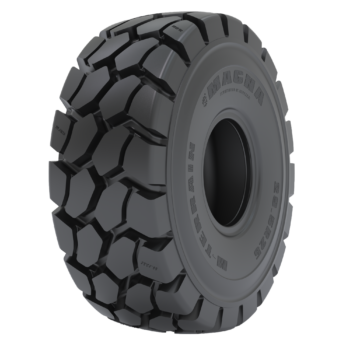
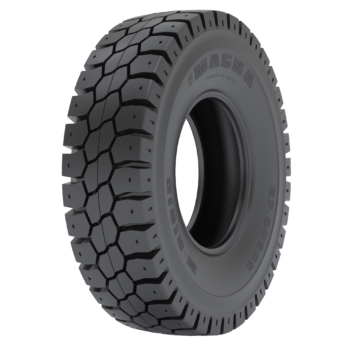
Use these records to identify recurring problems. Repeated shoulder damage may point to narrow roads, poor edge conditions or cornering behavior. Heat-related removals may require a review of payload, speed, cycle distance, inflation pressure or TKPH. Operator behavior also affects tire life. Heavy braking, rapid cornering, impacts and wheel spin can increase wear and damage. Compare multiple tires in similar applications over a meaningful period to create a reliable basis for purchasing decisions. Correct application matching supports a lower tire cost per hour. The Magna M-TERRAIN, Magna M-RIGID and Magna MA08 show how articulated dump trucks, rigid dump trucks and wheel loaders require different technical solutions. Confirm the machine, load, speed, cycle and site conditions before selecting a tire.

Turning Tire Data into Better Purchasing Decisions
Use cost per hour as part of a consistent decision-making process. Start by calculating the current cost per hour for each machine, tire position and application. Record why tires are removed and identify avoidable costs such as damage, downtime or incorrect pressure.
When testing another tire, use comparable machines, loads, routes and operating periods. Review cost per hour together with:
- Hours in service
- Tread wear rate
- Repair frequency
- Tire-related downtime
- Removal reason and casing condition
- Tons moved or production output
For haulage operations, cost per ton can add useful context. A tire may achieve a low cost per hour while supporting lower production. Combining both figures provides a clearer view of operational value.
The objective is to balance service life, productivity, safety, uptime and total operating cost. Magna Tyres supports fleets in selecting Mining & Earthmoving tires for their machines and applications. Reliable data and technical selection help you improve tire performance and gain better control over lifecycle costs.