.svg)
.svg)
.svg)

OTR Tyre Load Index and Speed Rating Chart
An OTR tyre’s load and speed index shows how much weight the tyre can carry at a specified maximum speed. Reading this code correctly helps you prevent overloading, control heat build-up and reduce avoidable tyre damage.
However, the load and speed index is only one part of tyre selection. Inflation pressure, operating conditions, machine configuration and application intensity also influence the tyre’s performance.
What the OTR Tyre Load and Speed Index Means
The load and speed index appears on the tyre sidewall as a combination of numbers and letters.
- The load index is a numerical code that represents the tyre’s maximum load capacity.
- The speed symbol represents the maximum speed associated with that load capacity.
You must assess these values together. A tyre’s permitted load can change when it operates at a different speed. This relationship is particularly important for OTR machinery, where high loads, long cycles and demanding surfaces can generate substantial heat.
How to Read an OTR Tyre Code
Consider a 23.5R25 Magna MA02 marked with the service descriptions 185B/201A2.
- 185B represents a maximum load capacity of 9,250 kg per tyre at a maximum speed of 50 km/h.
- 201A2 represents a maximum load capacity of 14,500 kg per tyre at a maximum speed of 10 km/h.
The higher load index does not automatically make 201A2 the preferred rating. It applies at a much lower maximum speed. The correct service description depends on how you use the machine.
Use the following steps when checking an OTR tyre:
- Locate the load index and speed symbol on the sidewall or technical data sheet.
- Find the corresponding load capacity and maximum speed in the chart.
- Confirm that the value applies to the tyre size and configuration in use.
- Compare the rating with the machine’s actual axle load, speed and duty cycle.
- Check the required inflation pressure for the operating load.
Tyres with the same pattern name can have different ratings depending on their size, construction and specification. Use the technical data for the exact tyre fitted to the machine.
OTR Tyre Load and Speed Rating Chart
The load index chart converts the numerical code on the tyre into a load capacity in kilograms. The speed rating chart shows the maximum speed associated with each symbol.
Common OTR speed symbols include:
- A2: up to 10 km/h.
- A6: up to 30 km/h.
- A8: up to 40 km/h.
- B: up to 50 km/h.
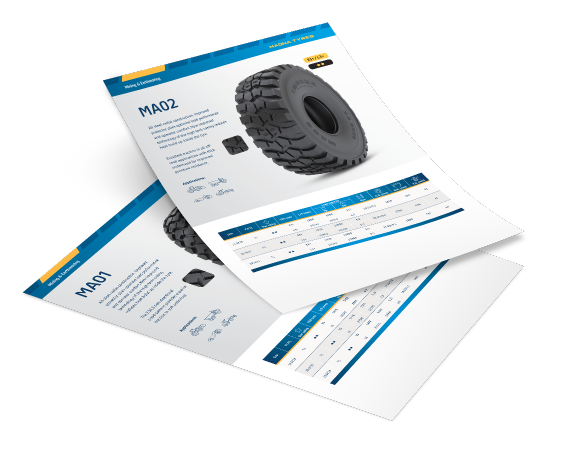
Download the complete reference table to compare OTR tyre load indices and speed symbols:
The chart provides a practical reference, but it does not replace the technical data sheet for the selected tyre. Verify the permitted load, speed and inflation pressure for the exact tyre size and application.
Why Inflation Pressure and Operating Conditions Matter
A correct load index does not compensate for incorrect inflation pressure. When the pressure is too low for the load, the casing flexes more and generates additional heat. When the pressure is too high, the tyre can have a smaller contact area and become more vulnerable to impact damage.
The speed symbol indicates a maximum speed under defined conditions. It should not be treated as a recommended continuous operating speed. Long haul distances, repeated loaded cycles, high ambient temperatures and abrasive surfaces can increase tyre temperature and affect service life.
Before selecting or operating an OTR tyre, assess:
- the actual load per tyre;
- the machine’s loaded and unloaded speed;
- the length and frequency of each cycle;
- the haul-road or working-surface conditions;
- the ambient temperature;
- the required inflation pressure;
- the risk of cuts, impacts and penetration;
- the machine and rim configuration.
For transport-intensive applications, TKPH provides an additional indication of whether a tyre suits the combination of average load and average speed. A complete application review helps reduce heat-related failures, protect uptime and control the cost per operating hour.
Selecting the Right OTR Tyre
The correct OTR tyre combines sufficient load capacity with a speed rating, construction, tread pattern and compound suited to the application. A tyre designed for loading work, for example, faces different demands from a tyre used for quarry transport or underground operations.
Before making a selection, match the tyre to the machine, axle position, operating load, maximum speed, cycle distance and surface conditions. A Magna Tyres partner can review these factors and help you select a reliable tyre specification for maximum uptime and a controlled Total Cost of Ownership.