


.svg)
.svg)
.svg)

EU Tyre Labels Explained: A Practical Guide for Truck Fleets
Choosing truck tyres involves more than finding the right size and comparing prices. Fuel consumption, braking performance on wet roads and external rolling noise also deserve attention. The EU tyre label helps you compare these characteristics using a standardised system.
But what do the letters and symbols mean, and how much can they tell you about a tyre's suitability for your vehicles? This guide explains how to read EU tyre labels and use them alongside the practical requirements of your fleet.
What is the EU tyre label?
The EU tyre label presents selected tyre performance information in a common format. It allows you to compare products using the same rating system, rather than relying on descriptions that may differ between suppliers.
Its three main ratings cover fuel efficiency, wet grip and external rolling noise. The label also identifies the product and includes a QR code for further information. Additional symbols may indicate performance in severe snow or ice conditions.
The current design has applied since 1 May 2021. If you remember an older label with sound-wave symbols, the present version uses letter classes for external noise instead.
For fleet managers and buyers, the label is a useful comparison tool. It does not replace checking whether a tyre is suitable for the vehicle, axle and work it will perform.
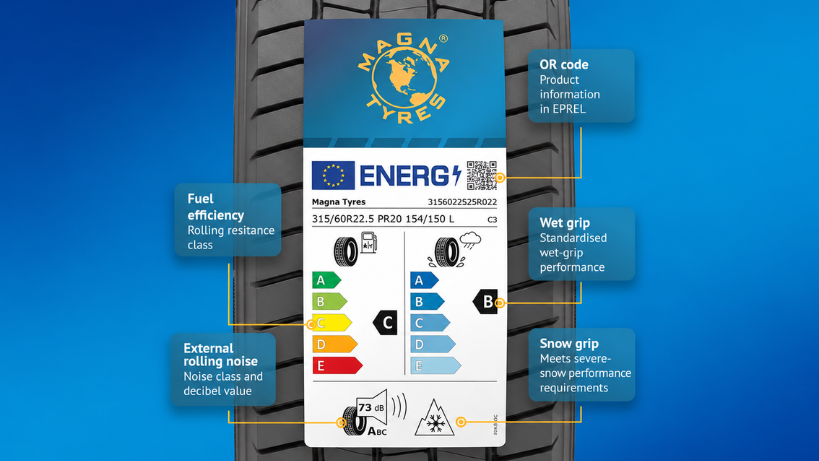
How do you read an EU tyre label?
Start by identifying the three main ratings. Fuel efficiency and wet grip use an A–E scale, with A representing the strongest performance. External rolling noise has a measured value in decibels and a separate A–C classification.
| Label characteristic | What it tells you | How it is displayed |
|---|---|---|
| Fuel efficiency | The tyre’s rolling resistance | A–E class |
| Wet grip | Performance under standardised wet-braking test conditions | A–E class |
| External rolling noise | Noise emitted outside the vehicle during testing | Decibel value and A–C class |
Then check the product details. The label needs to correspond to the tyre you are comparing, including its size and specification. Two tyres with the same profile name can have different ratings.
Read each characteristic separately. The letters do not combine into one overall quality score, and a strong result in one area does not establish performance in every other area.
Fuel efficiency: what does rolling resistance mean?
A tyre flexes as it rolls under load. That movement uses energy, some of which is released as heat. Rolling resistance describes the resistance associated with the tyre rolling along the road.
The fuel-efficiency rating reflects this characteristic. A tyre in a better class has lower rolling resistance under the standardised test conditions.
For a truck travelling long distances, energy use is an important part of operating costs. Comparing the fuel-efficiency ratings of suitable tyres can therefore help you assess your options. The principle also matters for electric vehicles, where energy consumption affects range.
However, the label does not predict your fleet’s exact fuel consumption. Vehicle load, route, speed, driving behaviour and tyre pressure also influence the result.
Use the rating alongside good tyre management. Check pressures against the appropriate vehicle and tyre guidance, and investigate uneven wear or repeated pressure loss. Selection and maintenance both matter when managing operating costs.
Explore these truck tyres for their low rolling resistance.
-
Trailer

M-TRUCK LH32
- 385/65R22.5
-
Steer / Trailer
M-TRUCK RG32
- 385/55R22.5
-
Steer/Trailer
M-TRUCK RG10
- 295/80R22.5
- 315/70R22.5
- 315/80R22.5


Wet grip: what does the rating tell you?
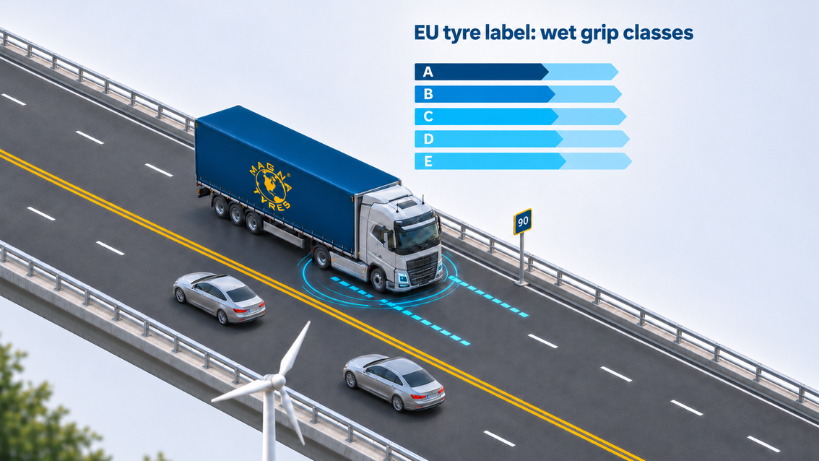
The wet-grip rating provides a standardised indication of performance when braking on a wet road. It helps you compare suitable tyres under defined test conditions.
Class A represents the strongest performance on the scale. A better class indicates better wet-braking performance in the test, but it does not specify a guaranteed stopping distance for your truck.
In everyday operation, speed, vehicle load, road surface, tyre condition and the braking system all affect braking. The label cannot account for every combination of these factors.
It is also useful to distinguish wet braking from other aspects of grip. The wet-grip class does not provide a complete assessment of cornering, aquaplaning resistance or traction on loose ground.
For your fleet, use the rating as one part of a wider safety assessment. Maintain appropriate following distances and include tyre condition and pressure in your inspection routine.
Explore these truck tyres for their wet-braking performance.
-
Trailer
M-TRUCK LH32
- 385/65R22.5
-
Drive
M-TRUCK RG22
- 315/60R22.5
- 295/60R22.5
-
Steer/Trailer
M-TRUCK RG31
- 385/65R22.5


External rolling noise: understanding the dB value.
The tyre noise rating concerns sound produced outside the vehicle as it passes by during testing. The label displays both a measured value in decibels, written as dB, and a noise class.
A lower dB value means less external rolling noise under those test conditions. The letter class provides an additional classification against the applicable limits.
This is different from the noise heard inside the cab. A tyre’s external noise rating does not measure cabin comfort or tell you how loud a particular vehicle will sound to its driver.
When comparing labels, look at the number as well as the class. Two tyres can share a letter while having different measured values. Compare appropriate specifications and keep external noise separate from other performance requirements.
Explore these truck tyres for their low external rolling noise.
-
Steer/Trailer
M-TRUCK RG10
- 295/80R22.5
- 315/70R22.5
- 315/80R22.5
-
All Position
M-TRUCK RG11
- 295/60R22.5
-
Drive
M-TRUCK RG22
- 315/60R22.5
- 295/60R22.5

What do the snow and ice symbols mean?
The three-peak mountain snowflake symbol, commonly called 3PMSF, indicates that a tyre meets the relevant performance requirements for severe snow conditions. You may find it on both the label and the tyre sidewall.
The ice-grip pictogram applies to qualifying C1 passenger-car tyres. It is not a C3 truck-tyre rating, so its absence on a truck tyre does not indicate a missing truck-specific result.
When planning winter operation, check the equipment requirements in the countries along your route. Use the markings together with an assessment of expected conditions. Our guide to extra tyre markings explains other information you may find on a sidewall.
What is the QR code on the tyre label for?
The QR code links to the corresponding product information in EPREL, the European Product Registry for Energy Labelling. This gives you another way to check the label details when comparing tyres.
Before ordering, match the information to your quotation. Check the size, service description and relevant version details instead of relying on a profile name alone.
You can find Magna label documents through our certifications page and relevant product pages. Keeping the label with your quotation helps purchasing and maintenance teams compare the same specification.
Do all truck tyres need an EU tyre label?
Truck and bus tyres fall within category C3 under the labelling system. However, some tyre categories are excluded, including professional off-road tyres.
A vehicle’s presence on a construction site does not, by itself, tell you whether its tyres are exempt. The product’s classification matters.
If you cannot find a label for a tyre you are considering, ask the supplier to clarify its classification and provide the applicable product information.
What does the EU tyre label leave out?
The label covers selected characteristics, not the whole working life of a tyre. It does not give you a complete assessment of mileage, damage resistance, retread suitability or performance on your particular routes.
That distinction matters when comparing total costs. A stronger fuel-efficiency class does not automatically mean longer tyre life, and a lower purchase price does not necessarily mean a lower operating cost.
Where reliable fleet data is available, review mileage, fitting, maintenance and replacement costs alongside the label. Consider the operating conditions behind those results before applying them to other vehicles.
Tyres serving different axle positions may have similar label values while fulfilling different jobs. Start with fitment and application, then use the label to compare suitable options.
How can you use the label when choosing truck tyres?
A practical comparison starts with the work your vehicles perform:
- Confirm the required tyre size, axle position, load and speed capability.
- Consider route lengths, road surfaces, payloads and seasonal conditions.
- Identify suitable tyres before comparing label classes.
- Check fuel efficiency, wet grip and external noise separately.
- Review the precise specification on the quotation.
- Consider maintenance needs and available service-life information.
For example, a long-distance operation may place particular emphasis on rolling resistance, while a regional fleet with frequent stops will also want to examine wet-braking performance carefully. Neither priority removes the need to assess all relevant requirements.
When exploring the Magna M-TRUCK range, use the product information to identify suitable profiles and the EU label to compare their individual characteristics.