


.svg)
.svg)
.svg)

Wheel Loader Tyres by Application: How to Choose the Right Option?
Wheel loaders operate in construction, quarrying and mining, but these applications place different demands on their tyres. A loader moving sand across a maintained construction site does not face the same risks as a machine working against a rock face or carrying material through a surface mine.
Selecting wheel loader tyres by machine size alone can therefore lead to unnecessary wear, heat build-up or tyre damage. The right choice starts with the application. Load, speed, cycle distance, surface conditions and damage risks determine which tread depth, construction and compound suit the operation.
Magna Tyres offers a broad range of Mining & Earthmoving tyres for different machines and operating conditions. This guide explains how to compare wheel loader tyres for general earthmoving, quarrying and surface mining.
Why the Application Determines the Right Tyre
Machine type provides a useful starting point, but it does not describe how the loader works. Two comparable wheel loaders can require different tyres because their operating cycles and surfaces differ.
Start with the actual load on each tyre. Include loaded and unloaded conditions, the material being handled and variations during the working cycle. Repeated overloading increases casing stress, deflection and heat generation. The selected tyre size, load capacity and inflation pressure must work together.
Next, record how the machine moves. A loader performing short loading cycles near a stockpile places different demands on its tyres than a machine travelling longer distances between a loading point and crusher. Average speed, loaded speed, cycle distance and the number of cycles per shift all influence heat build-up.
Surface conditions determine the required balance between traction and protection. Loose soil may require an open pattern that releases material and maintains grip. Hard and abrasive surfaces increase tread wear. Sharp rock, potholes and debris raise the risk of cuts, impacts and casing damage.
You should also inspect the tyres currently fitted to the machine. Repeated shoulder damage, cuts, chunking or irregular wear can reveal more than the total operating hours alone. These patterns may point to an unsuitable specification, incorrect inflation pressure, poor surface conditions or operator behaviour.
Our guide to earthmoving machines and their tyre requirements explains how these factors differ across loaders, dump trucks, graders and scrapers.
Choosing Wheel Loader Tyres by Application
The application determines which performance characteristics deserve priority. General earthmoving usually requires versatility. Quarry work places more emphasis on damage and wear resistance. Surface mining can add heavy loads, longer travel distances and greater heat exposure.
General Earthmoving and Construction
Wheel loaders in general earthmoving move soil, sand, gravel and other bulk materials. They may work on compacted ground, loose surfaces or partly paved areas during the same shift. Operating cycles are often shorter and conditions may change as the project develops.
A suitable tyre must provide a balanced combination of traction, stability, comfort and wear resistance. An aggressive, extra-deep tread may not be necessary when the surface presents a relatively low risk of cuts and impacts. Additional tread material also increases weight and can retain more heat.
For these applications, an L3-pattern tyre often provides an effective starting point. Its tread depth supports traction and wear life without introducing the heat considerations associated with deeper severe-service patterns. The final specification still depends on load, travel distance and surface conditions.
Pay attention to wheel spin. Excessive wheel spin removes tread rubber without increasing productivity. Correct inflation pressure, suitable tread design and controlled operating technique help transfer torque to the ground more effectively. Regular pressure checks also support stability when the loader lifts or transports material.
Quarry and Aggregate Operations
Quarries introduce sharper and more abrasive materials. A wheel loader may work at the face, manage stockpiles, feed a crusher or load haul trucks. Broken stone can damage the tread and sidewall, while hard surfaces accelerate wear.
Tyre protection becomes more important as the material becomes sharper and the loading area becomes less controlled. A deeper L4 or L5 tread can provide additional wear material and protection. Reinforced shoulders and sidewalls can also help resist damage during turning, stockpile work and contact with loose rock.
Deeper tread is not automatically the correct answer. A loader that travels longer distances at speed may generate too much heat on a very deep pattern. The loading area, route and cycle must therefore be assessed together.
Site maintenance remains part of tyre management. Removing spillage, repairing potholes and maintaining drainage can reduce impact damage and wheel spin. Read more about how haul road conditions affect mining tyre life to understand how road width, gradients, loose rock and surface maintenance influence tyre performance.
Surface Mining and Load-and-Carry Operations
Surface mining combines high loads with demanding operating cycles. Wheel loaders may load trucks, move material between stockpiles, feed crushers or support other production equipment. Some machines remain close to the loading area, while others perform repeated load-and-carry cycles.
For short, intensive cycles on aggressive rock, traction and damage resistance may lead the selection. Longer loaded travel introduces an additional priority: heat management. Tyre temperature rises through repeated deflection under load. Speed, cycle distance, inflation pressure, payload and ambient temperature all contribute to this process.
An L4 tyre can provide a useful balance for operations that require protection and traction while the loader still travels under load. An L5 tyre may be more suitable when cut resistance and tread wear are the dominant risks and travel distances remain controlled.
Calculate or verify the operational data before making this decision. Record the loaded and unloaded cycle, average shift speed, maximum speed, payload and time spent travelling. This prevents a visually impressive tread pattern from being selected for an operating cycle it cannot support efficiently.
Understanding L3, L4 and L5 Wheel Loader Tyres
TRA codes help identify a tyre’s intended application and relative tread depth. The letter L refers to loader and dozer service. The numbers indicate different tread-depth categories.
| Classification | General Characteristic | Typical Selection Priority |
|---|---|---|
| L3 | Regular tread depth | Versatility, traction and controlled heat generation. |
| L4 | Deep tread | Increased wear resistance and protection. |
| L5 | Extra-deep tread | Maximum tread volume and protection in severe conditions. |
These classifications are not quality rankings. An L5 tyre is not automatically better than an L3 or L4 tyre. It contains more tread material, which can support wear life and damage resistance but may also retain more heat.
The correct classification depends on the operation:
- Choose towards L3 when the loader works in mixed general-purpose conditions and travels more frequently.
- Consider L4 when the operation needs additional protection but still includes load-and-carry work.
- Consider L5 when severe abrasion, sharp rock and short intensive cycles create the greatest tyre risk.
Use this guidance as a starting point. The complete specification must also account for tyre size, load capacity, speed, inflation pressure, compound and regional availability.
Magna Tyres for Different Wheel Loader Applications.
The following three tyres demonstrate how product selection can change with the application. They are examples, not automatic recommendations. Confirm machine specifications and operating data before selecting a tyre.
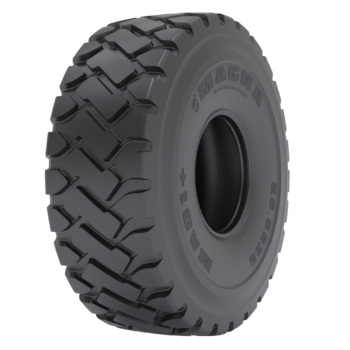
General Earthmoving: The Magna MA01+
The Magna MA01+ is an E3/L3 radial tyre developed for multiple earthmoving machines, including wheel loaders. Its tread is deeper than a standard E3/L3 pattern, while its compound and casing are designed to control heat build-up.
This combination makes the Magna MA01+ a suitable candidate for construction, general earthmoving and less severe quarry work. The radial construction also supports load performance and operator comfort. Available sizes range from 17.5R25 to 29.5R25, subject to regional availability.
Surface Mining and Load-and-Carry: The Magna M-TRACTION
The Magna M-TRACTION is an E4/L4 radial tyre for wheel loaders and articulated dump trucks. Its multi-block tread pattern supports grip, while the reinforced crown, shoulders and sidewalls provide protection against sharp material and lateral forces.
The tread compound and casing construction are designed to limit heat generation. This makes the Magna M-TRACTION relevant when a wheel loader combines demanding terrain with loaded travel. It is currently listed in size 29.5R25, so machine fitment and regional availability require confirmation.
Quarrying and Severe Conditions: The Magna MA08
The Magna MA08 uses an extra-deep L4/L5 tread design, depending on the selected size and specification. Large tread blocks and an open pattern support traction, while the protected sidewall helps resist cuts and operational damage.
This makes the Magna MA08 a strong candidate for wheel loaders working in quarries, abrasive loading areas and severe mining conditions. Its broad size range also covers different wheel loader classes. However, cycle distance and heat exposure must still be checked before selecting a deep-tread configuration.
-
E3/L3

MA01+
- 17.5R25
- 20.5R25
- 23.5R25
- 26.5R25
- 29.5R25
-
E4/L4
M-TRACTION
- 23.5R25
- 26.5R25
- 29.5R25
-
L5
MA08
- 17.5R25
- 20.5R25
- 23.5R25
- 26.5R25
- 29.5R25
- 29.5R29
- 35/65R33


Making the Final Wheel Loader Tyre Selection
A reliable wheel loader tyre recommendation requires more than the machine model and tyre size. Collect the following information before comparing products:
- Actual load per tyre in loaded and unloaded conditions.
- Required tyre size and rim specification.
- Average, loaded and maximum speed.
- Distance and duration of a complete cycle.
- Number of cycles per shift.
- Surface type and material being handled.
- Frequency and type of existing tyre damage.
- Current inflation pressure and tyre temperature.
- Seasonal changes in ground and ambient conditions.
This information helps identify whether the operation should prioritise versatility, traction, wear resistance, heat management or damage protection. It also makes it easier to compare tyre performance through operating hours and cost per hour rather than purchase price alone.
Our upcoming guide to cost per hour of mining and earthmoving tyres explains how service life, downtime, maintenance and productivity influence the real cost of a tyre.
No single tread pattern suits every wheel loader operation. Match the tyre to the work it performs, monitor its condition and review the specification when routes, loads or surfaces change. Explore our Mining & Earthmoving tyres or ask a Magna Tyres specialist to assess your machine and operating data.