


.svg)
.svg)
.svg)

Earthmoving Machines and Their Tyre Requirements
Why Machine Type Alone Is Not Enough.
Machine type provides a starting point. It shows how the equipment moves, carries its load and transfers force to the ground. It does not describe the complete duty cycle.
Consider two wheel loaders of the same size. One handles loose material on a maintained surface. The other loads sharp rock in a quarry. Both machines may accept the same tyre size, but their operational risks differ.
The first loader may prioritise traction, flotation and low heat generation. The quarry loader may require greater cut resistance, tread protection and casing strength.
Effective tyre selection combines:
- The machine.
- The operating conditions.
- The operational objective.
More tread, a higher load capacity or a heavier construction does not automatically improve performance. The specification must match the work.
Key Factors in Earthmoving Tyre Selection.
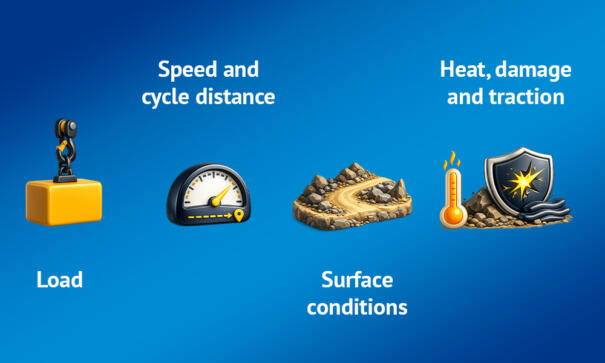
Collect accurate operating data before comparing tyre options. Load, speed, cycle distance, surface conditions and damage risks should lead the selection process.
1. Load.
Start with the actual load on each tyre. Consider the machine in loaded and unloaded conditions, including variations during the working cycle. Excessive load increases casing stress and heat generation. It can accelerate wear and raise the risk of tyre failure. Tyre size, construction, load capacity and inflation pressure must therefore work together. Use verified machine data and actual operating loads. Nominal machine capacity may not reflect conditions on site.
2. Speed and Cycle Distance.
Speed influences heat generation, particularly when machine travels longer distances under load. Record the average work-shift speed, peak speed and loaded speed. Also measure the distance of a complete cycle, the number of cycles per shift and the time spent loaded and unloaded. For repeated haul cycles, TKPH provides a useful selection value. TKPH combines mean tyre load with average work-shift speed. It helps determine whether the tyre and compound match the operation. Short cycles with frequent turns create different stresses from long journeys at sustained speeds. This information shows whether the operation should prioritise traction, heat resistance, wear resistance or a balance of the characteristics.
3. Surface Conditions.
The surface directly influences traction, wear and damage risk. Soft ground may require an open tread pattern that supports traction and releases material. Hard and abrasive surfaces place more emphasis on wear resistance. Sharp rock, potholes and loose debris increase the risk of cuts, impacts and casing damage. Conditions can also change throughout the year. A compacted road may become muddy or unstable during wet periods. Select the tyre for the conditions that create the greatest operational risk. Tyre specification is only part of the solution. Road design, drainage and maintenance also affect performance. Read more about how haul road conditions affect mining tyre life.
4. Heat, Damage and Traction.
Load, speed, deflection and cycle length all influence heat build-up. Tread depth and compound selection affect how a tyre generates and releases this heat.Deeper tread can improve wear and cut resistance. However, additional tread material can retain more heat. The deepest available tread is therefore not automatically the best choice. Sharp material can damage the tread, sidewall or casing. Inspect current tyres for recurring damage. Repeated cuts or irregular wear can reveal problems with the surface, operating behaviour or existing specification. Traction also depends on tread pattern, machine torque, surface conditions and inflation pressure. Insufficient traction increases wheel spin and wear. An unnecessarily aggressive tread may increase rolling resistance.
Articulated Dump Truck Tyre Requirements.
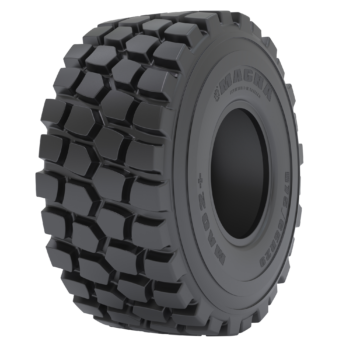
An articulated dump truck, or ADT, uses an articulated chassis to move over uneven and less developed terrain.
ADT tyres must manage:
- Loaded and unloaded cycles.
- Steering and lateral forces.
- Soft, loose or muddy ground.
- Cuts and impacts.
- Heat during longer cycles.
Traction, stability and self-cleaning performance often play an important role. An E3 specification may suit faster cycles or less severe surfaces. An E4 specification can provide more tread depth and protection in abrasive conditions.
Our Best Options for This Machine.
-
E3/L3

MA02+
- 750/65R25
- 875/65R29
-
E4/L4
M-TERRAIN
- 20.5R25
- 23.5R25
- 26.5R25
- 29.5R25
- 750/65R25
- 875/65R29
- 33.25R29
-
E4/L4
M-TERRAIN+
- 29.5R25
- 775/65R29


Wheel Loader Tyre Requirements.
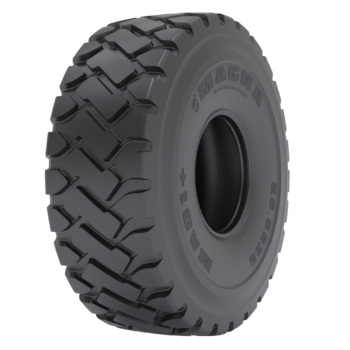
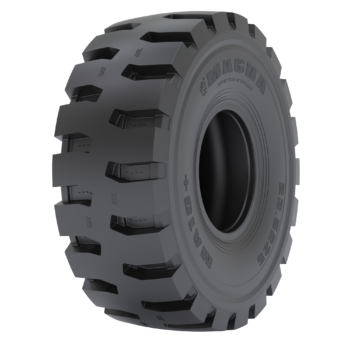
Wheel loaders complete repeated loading, lifting, turning and short-distance travel. Their tyres experience high torque, changing axle loads and frequent directional changes.
Selection factors include:
- Material density and bucket load.
- Loaded and unloaded axle weights.
- Cycle distance.
- Surface abrasiveness.
- Cut and puncture risk.
- Traction requirements.
- Heat generation.
An L3 tyre can provide a balance between traction, wear and heat management in general applications. L4 and L5 patterns offer deeper tread for increasingly severe conditions. An L5S pattern provides a smooth, protective tread for selected high-damage applications, but offers different traction characteristics. The operating environment must lead the choice. Our guide to wheel loader tyres by application explains how quarry, mining and recycling operations create different requirements.
Our Best Options for This Machine.


Grader Tyre Requirements.
Graders create and maintain level surfaces. Their tyres support steering accuracy, blade control and stable movement over unfinished ground.
The main requirements are:
- Directional stability.
- Predictable traction.
- Resistance to cuts and abrasion.
- Controlled wear.
- Stable performance on uneven surfaces.
An aggressive tread does not necessarily improve grader performance. When precision and stable ground contact are the priorities, additional tread depth may offer limited value.
Our Best Options for This Machine.

Scraper Tyre Requirements.
Scrapers cut, collect and transport material. Their duty cycle can combine heavy loads with higher travel speeds, making heat management an important selection factor.
Scraper tyres must balance:
-
- Traction during loading.
- Heavy and changing loads.
- Longer cycle distances.
- Abrasive surfaces.
- Sustained speeds.
- Heat resistance.
Loading conditions alone do not provide enough information. Assess the complete cycle before selecting a tyre.
Our Best Options for This Machine.
Earthmoving Tyre Selection Matrix.
| Machine | Common TRA Codes | Primary Tyre Challenges | Key Selection Priorities |
|---|---|---|---|
| Articulated Dump Truck (ADT) | E3, E4 | Cuts, impacts, wheel spin and lateral forces on rough terrain. | Traction, self-cleaning tread, lateral stability and cut resistance. |
| Rigid Dump Truck (RDT) | E3, E4, E4A | Heat build-up, heavy payloads, impact damage and long haul cycles. | TKPH rating, heat management, load capacity and predictable wear. |
| Wheel Loader | L3, L4, L5, L5S | High torque, wheel spin, cuts and casing damage during loading. | Correct TRA code, tread depth, traction and casing protection. |
| Grader | G2, G3 | Abrasion, uneven wear and steering stability. | Directional stability, even wear and controlled traction. |
| Scraper | E3, E4 | Heat build-up, abrasion, high loads and traction loss. | Heat management, load capacity, traction and casing protection. |
Connect Tyre Selection to Operating Cost.
Purchase price is only one part of tyre cost. Service life, fuel use, maintenance, damage and downtime all affect the result. A lower-priced tyre can become more expensive when it requires earlier replacement or causes additional downtime. A more protective tyre can also be inefficient when its construction exceeds the needs of the application. Compare tyres on productive operating hours, not purchase price alone. Read more about the cost per hour of mining and earthmoving tyres.
When to Ask for Technical Advice?
Every application is different. If you’re unsure which tyre best fits your machine and operating conditions, a short discussion with our technical experts is always worthwhile. Explore our Mining & Earthmoving tyre range or contact our specialists for advice on selecting the right tyre for your application.